
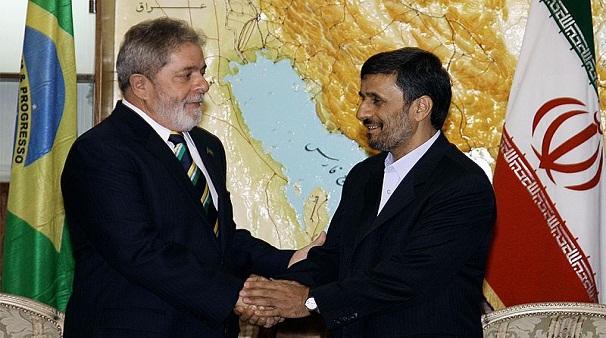
This Saturday, Lula will once again make world leaders stare in disbelief when he travels to Iran, one of the world’s most isolated regimes, to try broker, toegther with Turkey, a nuclear deal. Yet, also within Brazil, the few who care about foreign policy fiercely criticized the Brazil’s strategy prior to the visit. “I hope that he visits the prisoners”, Shirin Ebadi, Iran’s prominent exiled human rights advocate said yesterday in an interview with O Globo, a Brazilian newspaper. Clóvis Rossi, an influential columnist, recently wrote that Brazil’s green-and yellow national squad jersey was “covered with blood” after Ahmedinejad had been given one during an official visit. And José Serra, the leading presidential candidate from the opposition party, harshly criticized Lula for cozying up to a ruler reminiscent to Brazil’s military dictatorship both Lula and Serra fought against in the 1970s to establish democracy. Why then, does Lula, a savvy politician and diplomat who knows to read the voters’ minds like few others, engages with a human-rights abusing regime that may seek to build a nuclear bomb?
There are two main aspects that explain Lula’s policy.
The first reason can be explained by a genuine belief by President Lula and Foreign Minister Amorim that the Non-Proliferation Treaty (NPT) is flawed, and that the West uses the NPT to impose injust rules on the rest. Israel continues to deny its nuclear weapon status, and India was even recognized as a nuclear weapon state by the United States, even though it never signed the NPT. So why is the West so worried about Iran? Brazil also points out that nuclear weapons states have done too little to honor their obligations- namely, to reduce and eventually eliminate nuclear weapons stockpiles.
Secondly, Brazil believes that sanctions make little sense, and that they are often the prelude to military intervention. “Iran should not be pushed against the wall”, Lula stresses. He has a point. Sanctions are a popular but desperate effort to influence a misbehaving member of the family. Aside from punishing the local population, they rarely have the desired effect. Worse still, they often strengthen a rogue states’s resolve. However, Brazil is not categorically opposed to sanctions, but it only supports them if there is conclusive evidence that Iran wants the bomb. Lula argues that Iran’s case shows parallels to Iraq in 2003, when the United States wrongly concluded that Iraq was secretly developing weapons of mass destruction.
This is emphasized by the fact that Brazil recognizes its own past experience in Iran’s current troubles. In the 1970s, Brazil ran the risk of becoming the pariah Tehran is today. Under international pressure, especially from the United States, Brazil set up secret nuclear activities, which allowed it to develop indigenous enrichment capacity. In Brazil’s eyes, increased international pressure and a looming US intervention will only increase Iran’s urge to obtain nuclear weapons.
So is Lula right to travel to Tehran this weekend and engage? The answer is yes. On the one hand, Lula may be criticized for failing to condemn Iran’s human rights abuses and its failure to be more transparent about Iran’s intentions. His insistence to negotiate may give Iran the time it needs to build the nuclear bomb. But, Amorim is right to point out that a successful mediator needs to remain neutral. It is unclear whether Iran trusts Brazil, or whether Brazil has any influence over Iran, but it is be worth a try. After all, nobody really believes sanctions will convince Iran to change its mind anyway- so the argument that Lula’s diplomatic overtures give Iran more time is unconvincing. The White House even described Lula’s visit as the “last chance” Iran had to change its ways. If Iran really seeks to build the bomb, nobody can stop it, and not even President Lula – nor President Obama, for that matter – will be able to alter Iran’s strategy.
Read also:
Brazil and Turkey: Towards a Strategic Partnership?
Have Lula and Erdogan tamed Ahmadinejad?
For Brazil and Turkey, a Natural Defense Partnership Deepens
More than a dream? Obama’s vision of a nuclear arms-free world
Photo credit: Ricardo Stuckert (ABr)