
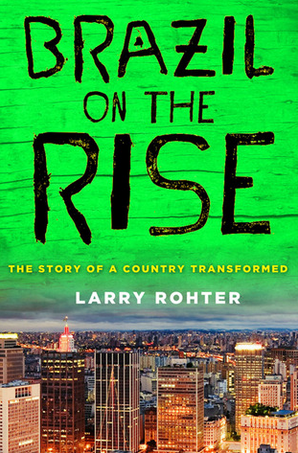
Book review: Brazil on the Rise. The Story of a Country Transformed. By Larry Rohter. St. Martin’s Griffin, 2012. 304 pages, $9.67 (kindle, amazon.com)
The fact that Brazil is on the rise is certainly nothing new, especially given its membership in the highly visible BRIC outfit created ten years ago. Yet while dozens of books on China and India flood the market every year, the number of authors who attempt to present a succinct yet comprehensive overview over contemporary Brazil remains low.
Larry Rohter’s attempt to fill the gap is therefore to be welcomed. Summarizing the years he spent as the New York Times’ correspondent in Brazil, an incredibly diverse country often misunderstood abroad, is a formidable challenge, and the author manages to dig deeper and undo some the most common misconceptions. Reading Rohter’s book is pleasant when he is writing about culture, his impressive experience in virtually all corners of Brazil, and his interviews with the country’s artists. His summary of Brazilian top-notch literature is particularly welcoming as it is often overlooked due to the dominant role Brazilian music plays abroad. His analysis on Brazil’s economy are well-researched but at times a bit dry. Here, he should have said more about his personal experience with the country’s CEOs.
Rohter’s book thus gives a good overview for those who need to get the basics about Brazil. It is an equally interesting read for Brazilians themselves as it says a lot about how an American experienced and interpreted everyday life in Brazil. In several instances, it becomes obvious that US-American and Brazilian culture occupy the two opposite extremes of the scale. For example, Rohter notes that Brazilian culture lacks any calvinist influence, an element that has strongly defines US-American psyche.
Two assertions make Rohter’s book controversial and more than a mere summary of current affairs in Brazil. First, he paints a fairly positive picture of former President Collor, who had to resign in 1992 after a corruption scandal in his third year in office. While most Brazilians remember Collor for his impeachment, Rohter argues that Collor was instrumental in opening Brazil’s economy to the world and making it more competitive. His second claim about the presence of racism in Brazil is unlikely to be well-received in a country where many regard comparisons between racial discrimination in the United States and Brazil as inappropriate. Rohter seeks to show the flaws in the argument of Jorge Amado, a Brazilian writer, who says s that while “the United States has millions of people who are not racists, it is a racist country”, while “Brazil has millions of people who are racists, but it is not a racist country.” While the book offers insufficient space to solve this complex topic in a satisfactory manner, it certainly is a welcome contribution to the debate.
Brazilians may not be used to discussing domestic problems with outsiders. Aside from his assertions about racism, Rohter poingnantly quotes former President Lula arguing that “those who failed to take care of their own forests (…) shouldn’t be sticking their noses into Brazil’s business, giving their two cents worth.” But this is the price the country will have to pay as it demands a more prominent international role. Just as all the positive aspects, such as Brazil’s successful cash transfer program Bolsa Familia, the negative ones, such as the destruction of the rain forest, the phenomenon of slave labor, and issues such as racism and social mobility are issues that will increasingly be debated on an international level. This is by no means limited to Brazil. Other rising powers such as India and China suddenly realize that their claim to a more powerful international role causes a surge in scrutiny by outsiders. The other day, an Indian friend of mine commented on twitter that she had put down Patrick French’s book on India because she disliked a “gora” analyzing (and judging) India (gora means “light-skinned” in Hindi and is a term often used for Westerners). Patrick French, a historian who has long studied India, is certainly not the last non-Indian to write about the world’s largest democracy. Rather, he is part of a growing number of India-watchers.
Germany’s most influential newspaper, the Frankfurter Allgemeine Zeitung, is one of the last large European papers that still has a correspondent in Buenos Aires, but none in Brazil. Yet the correspondent’s transfer to São Paulo is only a question of time. The result will be more feature stories, interviews and articles on Latin America’s giant. As any other country, Brazil faces plenty of problems. Some of them, such as inequality and urban violence, are likely to persist for decades to come. Yet as Brazil rises, Brazilians will have to get used to an ever growing attention and brighter spotlight. There will be lots of admiration, but also a lot of scrutiny and unsolicited advice.
Read also:
Book review: “The New Brazil” by Riordan Roett
Book review: “No One’s World” by Charles A. Kupchan
Book review: “New Powers: How to become one and how to manage them” by Amrita Narlikar